Introduction & Methodology Note
This report provides an overview of conflict-related social media content in Sudan during May 2026. It focuses on narratives of hate speech, incitement to violence, and expressions of solidarity across different geographies. It highlights how these narratives evolve online and reflect the country’s broader conflict dynamics.
The analysis draws on content from Facebook, X, and TikTok. The data collection combines account-based and keyword-based tracking, focusing on public posts that engage with conflict-related discourse. Content is classified to identify hate speech, incitement to violence, solidarity expressions, and actor affiliations (e.g., the Sudanese Armed Forces (SAF), the Rapid Support Forces (RSF), or unaffiliated), as well as references to specific regions and communities.
This report focuses on recurring narrative patterns and tactics observed across social media rather than on the intentions, affiliations, or authenticity of its authors. While some posts originate from accounts aligned with conflict actors, the narratives they promote are often reproduced by unaffiliated users and spread widely once they circulate online. We recognize that individuals can shift their perspectives and communication approaches over time, and this snapshot analysis should not be taken as a permanent characterization.
All analysis follows a do-no-harm approach and includes only public content. The report is written and disseminated by Build Up, based on participatory analysis work with a group of Sudanese researchers. All data is collected and processed using the Phoenix social media listening platform and can be made available for Sudanese and international researchers who are working towards peace in Sudan.
Main Results
Volume and Engagement
- In May 2026, hate speech posts accounted for 11.75% of all recorded posts. Compared with April 2026, this represents an 89.22% increase in posts containing hate speech, using the same data collection methodology. This rise is linked to military escalation, contested atrocity narratives, and debate around the release, return, and defection of prominent political and military figures. Online tensions also increased as political signals from both warring sides remained contradictory, while hate-driven discourse expanded beyond the SAF–RSF divide into tribal, regional, and foreign-actor narratives.
Spikes in Online Activity
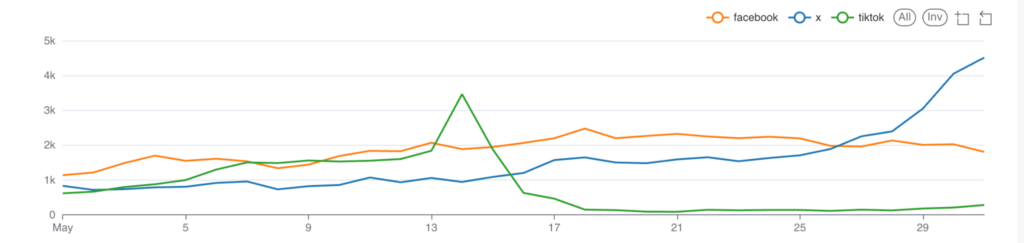
- May 4: Authorities in Khartoum accused Ethiopia of attempting to carry out attacks on Khartoum and Khartoum International Airport.
- May 11: Somoud civic coalition issued a statement emphasizing Sudan’s unity. Its chair, Abdalla Hamdok, stated that any ceasefire in Sudan would fail unless accompanied by a clear political track. On the same day, al-Safna, a senior figure in the RSF, announced his defection from the RSF.
- May 14: U.S. Senior Advisor for Arab and African Affairs Massad Boulos stated that Sudan’s warring parties were not ready to negotiate an end to the war. Meanwhile, the city of Nyala in western Sudan was subjected to renewed shelling.
- May 18: Tribal rhetoric escalated in eastern Sudan following local disputes between communities in the region and miners from Darfur over gold prospecting. Reports also circulated about the release of Abu Lulu, who is accused of war crimes in El Fasher, as well as the return of Mohamed Ibrahim Bagal, a former Islamist figure and RSF-aligned politician to Sudan.
- May 21: Abdel Fattah al-Burhan made remarks to Middle East Eye news outlet suggesting his readiness to engage in dialogue with the UAE under certain conditions. The Sudanese Sovereign Council denied these remarks later the same day in an official press statement.
- May 27: On Eid al-Adha, al-Burhan called for a broad Sudanese dialogue that would exclude only those he described as “steeped in Sudanese blood.” On the other side, Mohamed Hamdan Dagalo, known as Hemedti, stated that the RSF would continue its war against the Islamic Movement and claimed that it was the opposing side that rejected peace.
- May 30: The Rapid Support Forces attacked areas west of Bara, killing 40 civilians. Separately, the SAF-appointed governor of Khartoum made controversial remarks questioning the ownership of housing units in certain areas, claiming that their owners had not been known for a hundred years.
- May 31: Abdelrahim Dagalo delivered a speech denying RSF responsibility for the atrocities committed in El Fasher.