
Introduction & Methodology
This consultation was conducted to inform the International Ministerial Meeting on Sudan and support more inclusive engagement with the Sudanese public. It was implemented through the Mersal platform, in coordination with the UN Office of the Personal Envoy for Sudan as well as the EU Office of the Special Envoy to Sudan.
Mersal is a digital platform designed to enable large-scale public consultations among Sudanese communities inside the country and across the diaspora, with over 9,000 subscribers. It operates through a WhatsApp chatbot, allowing participation in a context marked by limited connectivity. For this consultation, the platform used a combination of the chatbot and the Pol.is platform. Pol.is is a deliberative tool that allows participants to vote on statements and submit their own contributions. Rather than selecting predefined options, participants engage by agreeing or disagreeing with a range of statements, which are then grouped to identify areas of consensus and divergence across the discussion. This approach makes it possible to capture both shared priorities and points of disagreement at scale.
The consultation was conducted between 25 March and 10 April 2026 and centered on the following guiding question: “What messages or priorities would you like to convey to the ministerial meeting in Berlin?” Throughout the consultation period, this question remained constant, while additional prompts were shared through the Mersal WhatsApp channel to guide discussion across key themes, including de-escalation, the political process, and humanitarian issues.
A total of 1,640 participants engaged through the platform, contributing 863 statements and casting more than 61,000 votes. Participation was voluntary and shaped by access to mobile connectivity and awareness of the platform, which may exclude some groups. As such, the consultation is not statistically representative of the Sudanese population. However, 44% of participants were based inside Sudan, and the findings reflect a broad range of perspectives from those directly affected by the conflict. The results should therefore be understood as an indication of commonalities and differences, rather than a full measure of public opinion.
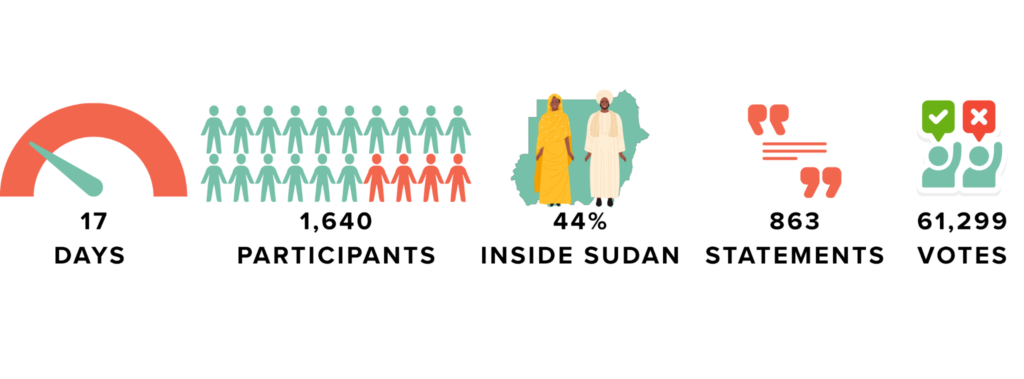
This consultation is based on voluntary participation and is not statistically representative of the Sudanese population. Participation was shaped by access to mobile connectivity and awareness of the platform, which may exclude some groups. At the same time, the findings reflect the perspectives of 1,640 participants, 44% of whom were based inside Sudan. The results should therefore be understood as an indication of commonalities and differences, rather than a full measure of public opinion.
This consultation is not intended to replace in-person dialogue processes; rather, it is designed to complement them by broadening participation and incorporating perspectives that may otherwise remain underrepresented.
Key Findings
This report is structured around three sections: common priorities, divisive issues, and opinion groups. The first section highlights issues where participants showed broad agreement across key themes, the second section focuses on divisive issues where participants expressed significantly different or polarized views, the final section presents the opinion groups identified through Pol.is, outlining distinct voting patterns and the different priorities and political tendencies that emerged across participants.