Introduction & Methodology Note
This report provides an overview of conflict-related social media content in Sudan during June 2026. It focuses on narratives of hate speech, incitement to violence, and expressions of solidarity across different geographies. It highlights how these narratives evolve online and reflect the country’s broader conflict dynamics.
The analysis draws on content from Facebook, X, and TikTok. The data collection combines account-based and keyword-based tracking, focusing on public posts that engage with conflict-related discourse. Content is classified to identify hate speech, incitement to violence, solidarity expressions, and actor affiliations (e.g., the Sudanese Armed Forces (SAF), the Rapid Support Forces (RSF), or unaffiliated) as well as references to specific regions and communities.
This report focuses on recurring narrative patterns and tactics observed across social media rather than on the intentions, affiliations, or authenticity of its authors. While some posts originate from accounts aligned with conflict actors, the narratives they promote are often reproduced by unaffiliated users and spread widely once they circulate online. We recognize that individuals can shift their perspectives and communication approaches over time, and this snapshot analysis should not be taken as a permanent characterization.
All analysis follows a do-no-harm approach and includes only public content. The report is written and disseminated by Build Up, based on participatory analysis work with a group of Sudanese researchers. All data is collected and processed using the Phoenix social media listening platform and can be made available for Sudanese and international researchers who are working towards peace in Sudan.
Main Results
Volume and Engagement
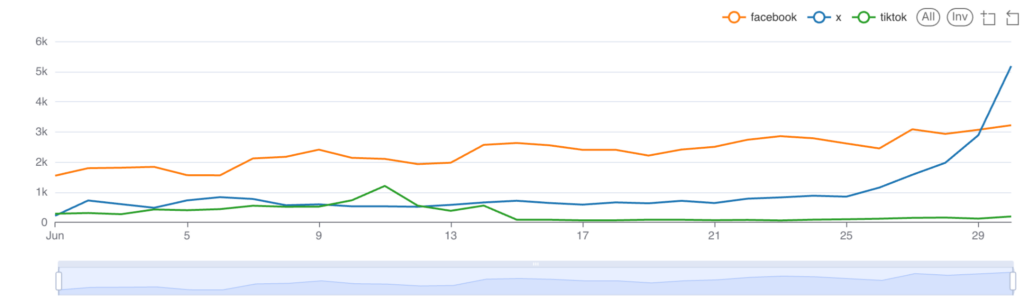
- In June 2026, hate speech accounted for 9.67% of all recorded posts, down from 11.75% in May using the same data collection methodology—a decrease of approximately 17.7%. This decline coincided with a month characterised by fewer major military escalations and less intense conflict-related activity than in May. While June remained politically contentious, many of the month’s major discussions centred on diplomatic initiatives, historical anniversaries, and civilian politics, which generated significant polarization but did not produce the same levels of hate speech observed during periods of heightened military escalation.
Spikes in Online Activity
- 3 June 2026, Online debate centered on responsibility for the massacre of the 3rd of June, 2010. SAF supporters placed full blame on the RSF, while RSF-aligned accounts accused the army and Islamist networks. Civilian voices held all components of the former Transitional Military Council responsible and rejected attempts to reinterpret the events in light of later political developments in ways that absolved one actor at the expense of another.
- 7 June 2026, Meetings of Somoud’s leadership and executive bodies coincided with a post by Minni Minawi describing the Tasis alliance and the RSF as “two sides of the same coin” and dismissing attempts to separate them as largely symbolic. The launch of separate Sudanese secondary-school examinations in RSF-controlled areas also triggered debate over educational fragmentation and the exclusion of students in different parts of the country.
- 9 June 2026, A joint statement by the United States, several European countries, the African Union, the European Union, IGAD, the Arab League, and the United Nations called for accelerated efforts to end the war and launch a civilian-led transition under an independent civilian authority. Reactions were divided, particularly within the SAF camp, where allied actors split between supporting and rejecting the statement.
- 13 June 2026, Reports of the sexual exploitation of refugee women and minors by international and local employees linked to Doctors Without Borders in Chad generated widespread online outrage. According to an Associated Press investigation, survivors reported abuse by staff working with the organization.
- 14 June 2026, comments by Khalid Omer Yousif in the UAE-based newspaper Al Bayan, praising the UAE’s role in ending the war and supporting sustainable peace, sparked a heated online debate. Critics presented the remarks as evidence of civilian forces’ alignment with the UAE and the RSF, while supporters viewed them as a positive political position.
- 23 June 2026, U.S. Senior Advisor for Arab and African Affairs Massad Boulos, said he had strongly urged the RSF leadership by phone to halt any actions that could endanger civilians in and around El-Obeid. On the same day, the SAF announced that it had taken control of the Al-Bar area in Blue Nile, renewing debate over the viability of military solutions. The dismissal of Sovereignty Council Secretary-General Lieutenant Gen Mohamed Al-Ghali and his replacement by Lt Gen Ahmed Saleh Abboud also drew attention, particularly amid claims that Al-Ghali had exercised unusually broad authority.
- 27 June 2026, Remarks by Masad Boulos at the UN Security Council, accusing the SAF of failing to respond to or accept a truce proposal, triggered widespread controversy. Sudan’s UN representative said that a response had already been delivered to the US side. SAF-aligned accounts accused Boulos of acting as a cover for the UAE, while anti-SAF voices cited the dispute as evidence of the army’s obstruction and unwillingness to pursue peace.
- 30 June 2026, Civilian forces marked the anniversary of the 30 June 2019 demonstrations by recalling the atrocities of the current war, calling for peace, and linking Sudan’s present crisis to the Islamist-backed coup of 30 June 1989. Notably, Islamist and former-regime supporters also openly celebrated the 1989 coup online, perhaps more visibly than at any point since the revolution. The date therefore became a site of competing narratives: liberation and resistance in 2019 versus the establishment of the Islamist regime in 1989.