This paper was written by Julie Hawke and Helena Puig Larrauri. Current platform policies reinforce conflict models that are both dyadic – framing disputes as occurring between two opposing parties – and agentic – treating individuals as the primary drivers of conflict escalation or resolution. In ‘The Third Side’, William Uryargues that we can’t think … Read more
This publication was written by Julie Hawke, Helena Puig Larrauri, Andrew Sutjahjo and Benjamin Cerigo. Originating from a unique partnership between data scientists (datavaluepeople) and peacebuilders (Build Up), this commentary explores an innovative methodology to overcome key challenges in social media analysis by developing customized text classifiers through a participatory design approach, engaging both peace … Read more
Authored by Helena Puig Larrauri as part of the Accord by Conciliation Resources. A volume on innovations in mediation would be amiss without a section addressing the potential and risks of digital technologies. Technology and innovation are entwined, both because technological advances are the result of innovative industry, and because technological advances very often catalyse … Read more
Authored by Julie Hawke as part of the Accord by Conciliation Resources. Technology holds particular promise as a means to reach the goal of inclusion in mediation and peace processes. Digital tools are able to address concrete barriers that otherwise hinder participation, such as geographic distance, language needs, limited access to information, low literacy, and … Read more
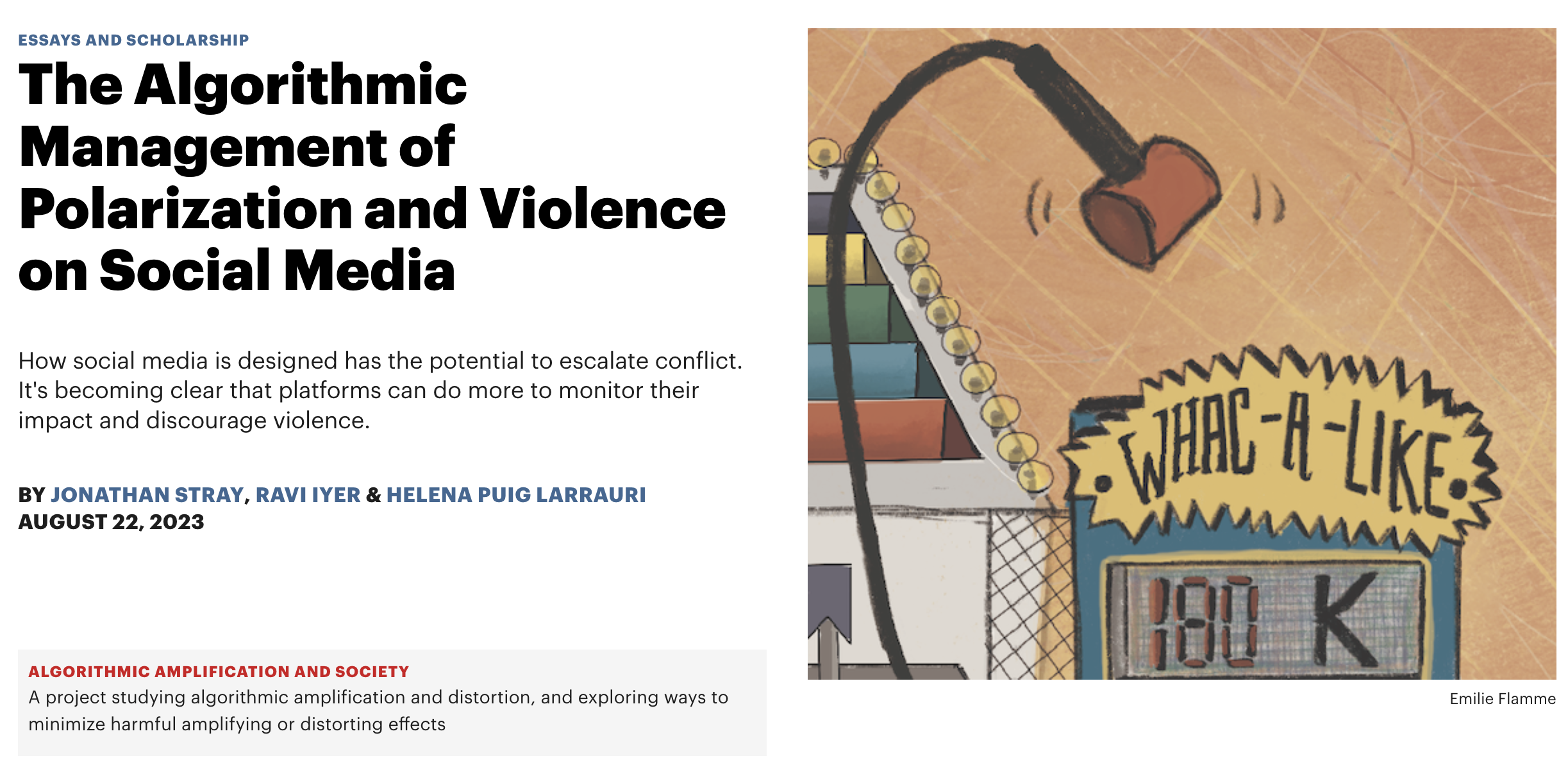
This paper was written Jonathan Stray, Ravi Iyer & Helena Puig Larrauri, Knight Institute. Social media platforms are involved in all aspects of social life, including in conflict settings. Incidental choices about how they are designed can have profound effects on people when conflict has the potential to escalate to violence. We review theories of … Read more
This paper was written by Helena Puig Larrauri and Anne Kahl and published in the Stability Journal. Abstract: New technologies are changing how and when we learn about events and choose to respond to them. Mobile phones and the internet have altered how we engage with the world. With technology usage expanding rapidly in the … Read more
Ahmed M. Musa brings over 12 years of diverse experience in the development, humanitarian, and research sectors. From 2022 to February 2024, he worked as a Senior Researcher at the Peace Research Institute Oslo (PRIO), focusing on community humanitarianism during protracted crises. During his tenure at PRIO, he led two research projects: “Transitioning Somalia to Direct Elections: Lessons from Somaliland” and “Stabilisation”.
Ahmed holds a PhD in Dryland Resource Management, and from 2020 to 2022, conducted postdoctoral research on diaspora humanitarianism in the context of complex crises. Previously, he was the Head of Research and Data Analysis at the Observatory of Conflict and Violence Prevention (OCVP), he managed projects at ActionAid International Somaliland and served as the Training Manager for the Somaliland National Electoral Commission (NEC).
Allan Cheboi is an AI Ethics and governance, cyber research and policy specialist with extensive experience supporting humanitarian organisations, civil society, and state actors in navigating emerging AI/ digital threats and opportunities. Allan's expertise ranges from cybersecurity, ethical AI design, custom machine learning applications, and digital forensics, particularly in conflict-prone and underrepresented contexts. Passionate about developing grounded AI systems that serve public interest technology and inform policy reform across Africa and globally.
Allan has a keen interest in deciphering how organised groups exploit digital spaces for criminal activities, to influence public opinion, and to influence democratic processes globally. He brings a wealth of experience from his previous roles in cybercrime investigation and forensic audit at KPMG and from his tenure at Code for Africa leading a team of data scientists and forensic researchers to track the actors, TTP’s and narratives used on social media to influence online communities. At Build Up, Allan supports digital peacebuilding initiatives, providing partners with crucial insights into the digital landscape to foster more resilient and informed communities.
Caleb is an explorer of digital spaces and has researched and applied various advanced technologies to address election violence, good governance, extremism, conflict mitigation and inclusive development. At Build Up he manages digital conflict programs, information ecosystems and depolarization projects in Africa. He also teaches data analytics for sustainable peace-building at the United Nations Systems Staff College (UNSSC) in Turin.
He has worked with different peace actors across Africa to respond to online harms such as hate speech, bullying and harassment, mis/disinformation and violent conflict by applying digital tools and engaging with technology companies. He has extensive experience and skills in digital transformation and engagement, media literacy, analytics, digital media monitoring and community building. Caleb also sits on the board of PeaceRep.
Helena is the co-founder of Build Up, a peacebuilding collective with an international reputation for excellence at the intersection of peacebuilding, mediation and technology. Over the past decade, she has mentored, trained and supported hundreds of civil society actors to design and implement technology interventions to peace processes, including address misinformation, hate speech and polarization in digital spaces. She has designed and deployed AI-enabled public consultations on peace and conflict issues, interventions to understand and address misinformation, hate speech and polarization, and hybrid online-offline peacebuilding programs. She also led the development of Phoenix, an open-source, AI-enabled, free platform for peacebuilders and mediators to conduct social media listening that now has hundreds of users. Helena has published extensively on these subjects, and is regularly called upon by senior mediators at multi-lateral organisations (e.g. OSCE, AU, UN agencies) to provide advice on how to approach and integrate the use of digital technologies and AI in their work.
Helena is also a Senior Advisor on Digital Technologies and Mediation to the United Nations Mediation Support Unit, where she has supported the development of knowledge with regards to the use of digital technologies and AI in UN Missions and Resident Coordinator offices, and provided operational assistance as required toUN envoys, senior officials and UN representatives leading mediation, facilitation and dialogue processes. She is a member of the FCDO's Civilian Stabilisation Group roster, and an Ashoka Fellow. She holds a BA in Politics, Philosophy and Economics from Oxford University and a Masters in Public Policy (Economics) from Princeton University.
Jerry has spent the last thirty years honing his skills as a change agent, from structural engineering in the United States to international peacebuilding around the world. Jerry now uses these skills to help define the concept of peace engineering. Both in support of curriculum development, as an adjunct lecturer, and with peace engineering fellows, he is working with a number of universities in the US that are introducing peace engineering into their engineering curricula and field work. In addition to his peace engineering work with Build Up, Jerry continues to support electoral work in the Somali region, where he has worked closely with Somali institutions in the delivery of electoral processes which underpin their homegrown democratization efforts.
Julie Hawke is committed to understanding the impacts of digital technologies on conflicts and how best to leverage their use in strategic peacebuilding efforts. She has over a decade of experience in third-party conflict engagement, global youth peace education, and digital peacebuilding program design and management. Bridging scholarship and practice, Hawke is a doctoral student of peace studies and sociology at the University of Notre Dame’s Kroc Institute for International Peace Studies, where her research centers on defining conditions for positive intergroup contact in online spaces. She has produced research and resources for practitioners that include “The Digital Peacebuilder’s Guide” (2022), “Monitoring of Social Media Provisions in Peace Agreements” (2024), and “Digital Peacebuilding 101: Introducing Technology for Peacebuilding” (2020). On the Build Up team, she co-leads social media-based peacebuilding and analysis programs, training and online courses, and research and policy initiatives.
Mahmoud first joined Build Up as a fellow within the Digital Steps program and is now a full-time team member focusing on peace innovators programs and running participatory consultations in the MENA region. Prior to Build Up, Mahmoud supported programs advocating for transitional justice in Syria and managed several local and international campaigns for the cause. His work consistently centers on community mobilizing, participant-focused training, and youth engagement. Mahmoud is also the founder of “Bebasata”, a social enterprise that uses animation to spark conversations about peace in Syria.
Megan is a peacebuilding professional based in East Africa with a decade of experience designing and implementing complex programs in collaboration with civil society organisations, government, and international partners. Her work focuses on participation and inclusion in peacebuilding and governance processes. She is passionate about innovation in the field of peacebuilding – in the tools we use, the programs we design and implement, and how we work as a community. Megan holds a BSc in International Relations from the London School of Economics and an MA in International Security from Sciences Po, Paris.
Meghan supports elections and democratization in the Somali region and always tries to do so with a peacebuilding approach by ensuring all support contributes to a locally owned and inclusive democratization process. She brings 7 years of democratization experience in the Somali region. This includes technical assistance to electoral commissions across all operational departments, and support to other democratization stakeholders such as civil society organizations. Outside of Build Up, Meghan likes to explore new and fantastic worlds through books, and explore her own world with long walks around Nairobi.
Michaela is a Chicana peacebuilder from the Pacific NW region of the US. For more than two decades, she has supported conflict transformation initiatives led by civil society, government, INGOs, and the UN in 20+ contexts across five continents. At Build Up, Michaela nurtures a nonviolent and values-driven approach to nurture individual and collective wellbeing amidst the complex systemic and ethical challenges deeply-rooted in the field of peacebuilding. She holds a Bachelor’s degree from Georgetown University, and Executive Master from The Graduate Institute, Geneva.
Rita is a digital peacebuilder and a performance artist at heart. At Build Up, she has designed and implemented training for young people to develop digital peacebuilding skills, conducted participatory processes of social media analysis in different contexts in West Africa and Western Europe regions to understand polarization and intimidation online, and has advised institutions on how to integrate digital harm in their conflict analysis frameworks. Before Build Up, she collaborated with a CSO working on psychosocial and legal support to refugees and migrants and co-led an anti-racist initiative between universities in the Netherlands. She is based in Barcelona.
Shadiya is a long-time advocate of Somalia’s democratization process, believing it is vital to state and peacebuilding. She has over 15 years of experience in peacebuilding and democratization. Shadiya previously worked with Interpeace, Sahan and UNOPS in the financial management of grants and complex programs including operational support to elections and voter registration. She has a business administration degree, and in her free time is currently pursuing a master of peace and conflict studies at the University of Hargeisa.
Cordula works as a process and dialogue facilitator, adult educator, mediator and coach. She has specialized in participatory approaches to political and social participation, polarization, collective and transgenerational trauma and the political dimensions of loneliness in Switzerland and beyond.
After working for 13 years for local, national and international governmental and non-governmental organizations and research institutes in peacebuilding and development, Cordula started her own core and core coaching business more than 12 years ago. Cordula studied political science and international relations, among other things, and obtained her PhD in peace and conflict research.
Cordula engages on conflict transformation related to COVID-19. She was a founder of the Swiss “Specialist Unit for Dialogue and Participation”, which was initiated during the acute COVID-19 lockdown period. The goals were to advise the Swiss federal government, cantons and communes on communication and de-escalation strategies and the development and implementation of forms of dialogue and participation. The unit has been closely observing and analyzing the increasing polarization in Swiss society since April 2020 and turned to the federal administration with specific proposals for de-escalation and the establishment of dialogue.
David Rincón is a Colombian psychologist, museologist, and DJ with over 18 years of experience in education, cultural management, and peacebuilding through heritage, memory, and the arts. He has worked in Colombia, Mexico, and other countries designing strategies for violence prevention, community strengthening, and informal education in conflict contexts.
As part of MasterPeace Mexico, he coordinated the Barrios de Paz Atlampa project, a violence prevention methodology that combined community participation, affordable technologies, local narratives, and urban art. His work has explored art and music as tools for reconciliation, directing the PeaceTalks series and documenting cultural processes linked to peacebuilding.
David has used radio as a space for resistance and dialogue. He has been the producer and host of Champetapunk on Radio Nopal and has participated in the Museum of Radio, a laboratory for sound experimentation. He curated the K-Z Radionáutica project for the exhibition Angazi pero estoy seguro at the Museo Tamayo and has worked on DIY initiatives such as Bogotrax, a 20 years old electronic music festival, exploring the intersection of art, technology and cultural transformation.. As a DJ, he blends diverse musical influences, using sound as a medium to connect people and narratives in both cultural and activist settings.
He has also been a lecturer at the Pratt Institute in New York and has designed educational experiences in Latin America and the United States. His approach combines research, cultural mediation, and innovative communication strategies to create spaces for dialogue and social transformation.
Guy Banim brings over two decades experience in peace mediation and preventive diplomacy rooted in his early career implementing the peace agreement in Northern Ireland. He later worked for the EU in Nepal, Afghanistan and Ethiopia and as team leader of the EEAS Mediation Support Team in Brussels. Guy has supported local actors in diverse contexts such as Mozambique, Myanmar and Zanzibar for organisations including UNDP, Crisis Management Initiative, European Institute of Peace, Centre for Humanitarian Dialogue and ACCORD.
Guy is a Visiting Professor at the College of Europe teaching a course on EU and Peace Mediation. He has published on the EU approach to peace process support and was co-author of HD Centre Mediation Practice Series 8 “Peacemaking and new technologies: Dilemmas and options for mediators”
Hussam is a Sudanese political activist, who over the past eight years has worked on issues of democratization, justice, and public freedoms. He has participated in establishing several youth initiatives and formulating a set of public policies. He believes that all Sudanese, regardless of gender, ethnicity, or region, should have guaranteed participation in Sudan’s political space.
Jacob is a finance professional and humanitarian enthusiast with over 14 years of experience in strategic financial management, accounting, and operations across multiple high-stakes international environments, guiding complex financial and administrative operations in Kenya, Somalia, South Sudan and Nigeria. Jacob has previously worked with Interpeace, Danish Refugee Council (DRC), Medair International, World Relief International and Intersos leading and supporting financial and operational management of multi-million-dollar donor funded grants in conflict or post conflict contexts across Africa and beyond. His expertise extends to financial management, grants compliance, operational optimization, risk management and financial Management capacity building for local actors.
Jacob holds Master of Business Administration (MBA) in Strategic Management, Bachelor of Commerce in finance and accounting and a registered member of the Institute of Certified Public accountant of Kenya (ICPAK).
Jean Marie Ndihokubwayo is a peacebuilding mentor, audiovisual researcher, and award-winning filmmaker from Burundi. For over two decades, he has worked at the crossroads of storytelling, civic technology, and social transformation. As a mentor with Build Up, he supports youth-led peace tech initiatives across West Africa. Prior to that, at the Centre d’Alerte et de Prévention des Conflits, he led the production of participatory media tools to support dialogue and community cohesion in the Great Lakes region.
His creative work has received multiple international awards, and he continues to train and inspire young filmmakers through his leadership in Burundi’s cultural sector. Jean Marie holds a Master’s degree in Documentary Film Directing from the Erasmus Mundus DocNomads program.
Luke is a PhD student in computer science at King’s College London interested in the intersection: algorithms ∩ conflict. His research currently focuses on how social media recommender systems can be designed to mitigate conflict risks, an idea sometimes called “bridging-based ranking”.
He coauthors the Understanding Recommenders project of the Center for Human-Compatible AI at UC Berkeley, is a member of the GETTING-Plurality Research Network in the Allen Lab for Democracy Renovation at Harvard University, and a research affiliate of the Machine Intelligence and Normative Theory Lab at Australian National University. Previously, Luke has worked with or advised Ofcom, the newDemocracy Foundation, and Meta. His background is in probability and statistics.
Nabila is a human rights specialist working at the intersection of gender equality, peace and security, and digital governance. She has worked for NGOs, IGOs, and the private sector, managing donor projects, designing inclusive programs, researching and leading advocacy and policy initiatives that address structural inequalities, strengthen civic space, safeguard marginalized groups, and support peace mediation efforts.
She holds advanced degrees in Gender, Peace and Security from the London School of Economics and International Affairs from the National University of Singapore. With an intersectional, Global Majority perspective and a track record of collaborative problem-solving, she is committed to advancing rights-based approaches and long-term solutions in humanitarian and development contexts.
Sharmarke has more than 10 years’ working experience in democratization & electoral processes, governance, peacebuilding, civic education, and research with strong ability to coordinate and work with both small and large teams.
He has been involved in numerous studies, reviews and participatory processes on programmatic and political matters relating to transitioning Puntland from clan-based system to a system of mutli-party government.
A smart creative that has a passion for building data-driven software in an agile way that can create value for organizations from the get-go. He has an unquenchable thirst for knowledge, constantly exploring logic, design patterns, deep work, technology and much more. With his strive to always produce high-quality work, challenging himself and colleagues to create software that they can be proud of. His unusual and innovative relationship with computers means that he can bring interesting perspectives to a company and the development process.
A writer, actor and peacebuilder living in Berlin. He was part of Build Up's core team from 2017-2021, and he currently chairs Build Up's German nonprofit arm. He was an original architect of the Phoenix platform and has supported many Build Up projects.
Most of his time is spent developing and producing creative work for film, stage and audio, and coaching actors and storytellers. His creative work has a research focus, blending different modes of play, improvisation and performance techniques. He also often takes on technical roles in projects, with experience in set-building, camera, editing and sound design. He studied acting and teaching at the Michael Chekhov International Academy, and he holds a B.A. from Hampshire College in storytelling, arts and performance.